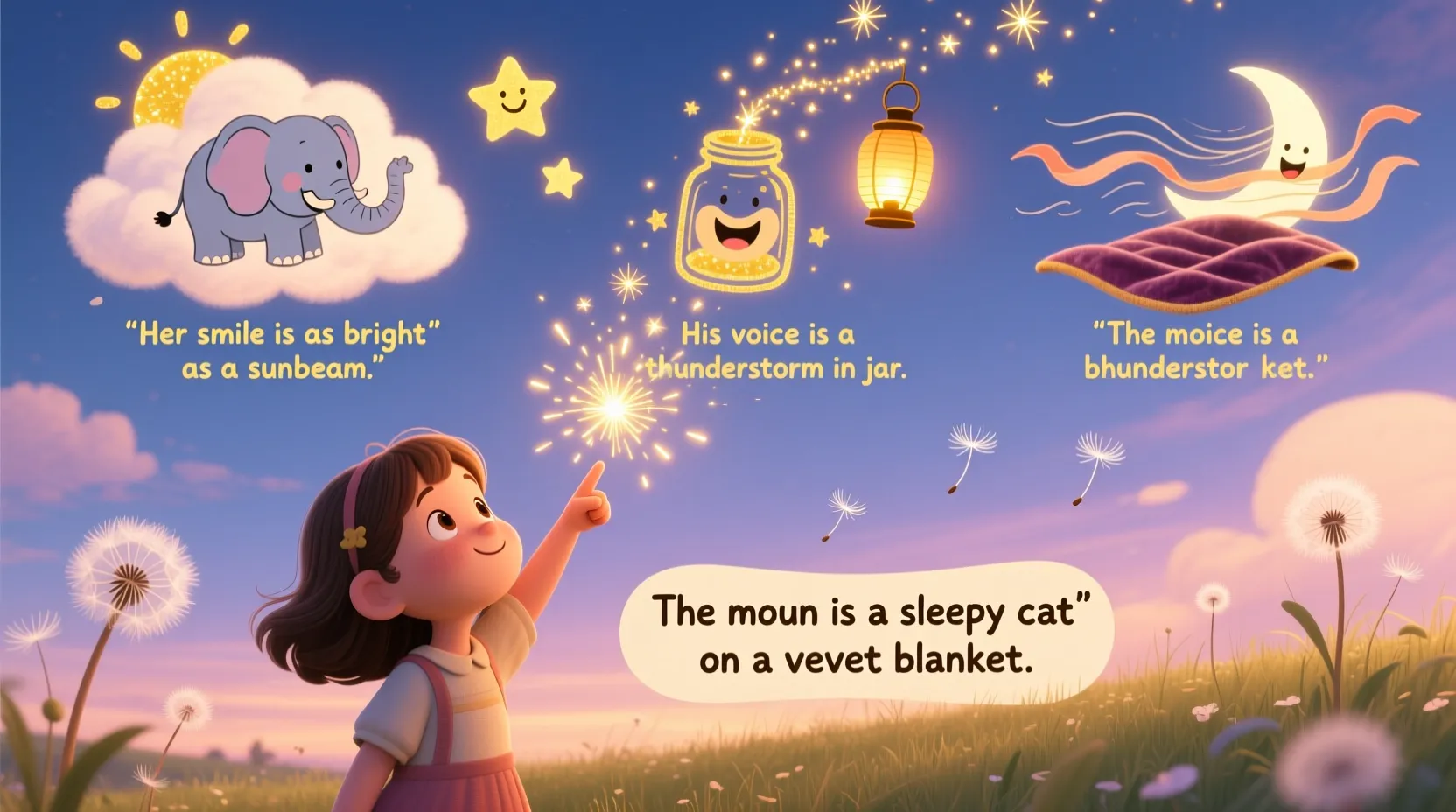
Learning language can be magical when words come alive through imagination! 🌈
Similes and metaphors help kids paint pictures with words — turning simple sentences into creative expressions. Whether your child is writing a story, poem, or school assignment, understanding these comparisons makes language fun and powerful.
In this guide, we’ve gathered 100+ kid-friendly similes and metaphors that are easy to understand, exciting to read, and perfect for young learners. From comparing animals and nature to describing emotions and adventures, these examples will inspire kids to think, write, and dream creatively! ✨
🧠 What Are Similes and Metaphors?
Both similes and metaphors compare one thing to another — but they do it in slightly different ways. They make language more exciting and help kids express ideas in vivid, creative ways.
💫 What Is a Simile?
A simile compares two things using the words “like” or “as.”
Example: Her smile is as bright as the sun.
It paints a clear picture by showing how one thing resembles another.
🌈 What Is a Metaphor?
A metaphor goes one step further — it says that something is something else.
Example: Her smile is sunshine.
Metaphors make the comparison stronger and more imaginative.
⚖️ Simile vs. Metaphor in Simple Terms
- Simile: Uses “like” or “as” → “He’s as quick as lightning.”
- Metaphor: Says one thing is another → “He is lightning.”
Both make writing sparkle — similes are gentle and clear, while metaphors are bold and poetic.
✏️ Why Are Similes and Metaphors Important for Kids?
Children naturally love stories, rhymes, and wordplay. Learning similes and metaphors helps them:
- Expand vocabulary
- Think creatively
- Understand abstract ideas
- Write more expressively
- Enjoy reading and poetry more deeply
When kids describe feelings or situations through comparisons, they learn to express themselves in ways that connect emotion and imagination.
🌼 50+ Similes for Kids (With Meaningful Imagery)
Similes make writing come alive with pictures and emotions. Here are fun, easy-to-understand examples across different themes.
🦁 Animal-Inspired Similes
- As brave as a lion
- As busy as a bee
- As quiet as a mouse
- As sly as a fox
- As proud as a peacock
- As playful as a puppy
- As gentle as a lamb
- As strong as an ox
- As stubborn as a mule
- As graceful as a swan
🌤 Nature and Weather Similes
- As bright as the sun
- As cold as ice
- As light as a feather
- As clear as crystal
- As white as snow
- As smooth as silk
- As fresh as a daisy
- As fast as lightning
- As quiet as falling snow
- As dark as midnight
🍎 Food & Everyday Life Similes
- As sweet as honey
- As flat as a pancake
- As cool as a cucumber
- As hot as an oven
- As easy as pie
- As slow as molasses
- As crunchy as an apple
- As sticky as glue
- As dry as toast
- As sour as lemon juice
💬 Emotions & Personality Similes
- As happy as a clam
- As sad as a rainy day
- As calm as a still lake
- As nervous as a cat in a thunderstorm
- As proud as a king
- As fierce as a storm
- As gentle as a breeze
- As brave as a superhero
- As excited as a puppy with a new toy
- As cheerful as sunshine
🏫 School & Learning Similes
- As sharp as a tack
- As bright as a star
- As curious as a cat
- As steady as a clock
- As eager as a beaver
- As patient as a teacher
- As fast as a calculator
- As helpful as a guide
- As quick as a flash
- As deep as the ocean of ideas
🌟 50+ Metaphors for Kids (To Fire Up the Imagination)
Metaphors are a step beyond — they say something is something else. This helps create strong, emotional pictures in our minds.
🐾 Animal Metaphors
- My brother is a bear in the morning.
- She’s a peacock showing off her new dress.
- The classroom was a zoo.
- My dad is a lion when he protects us.
- The baby is an angel.
- His voice is thunder in the room.
- The dog is a tornado of energy.
- She’s a butterfly, fluttering through the garden.
- The cat is a shadow in the night.
- The students are busy bees buzzing with ideas.
🌊 Nature & Weather Metaphors
- The sky is a blanket of stars.
- Time is a river that never stops.
- The sun is a golden coin in the sky.
- The wind was a whisper through the trees.
- His anger was a volcano ready to erupt.
- The snow was a white carpet on the ground.
- Her laughter was music in the air.
- The storm was a giant stomping through the clouds.
- Life is a roller coaster.
- The ocean is a mirror for the sky.
💖 Emotional & Inspirational Metaphors
- Hope is a candle in the dark.
- Her smile is sunshine.
- Fear is a shadow that follows you.
- Courage is a fire that never goes out.
- Friendship is a garden of joy.
- Love is a journey without end.
- Kindness is a bridge between hearts.
- Laughter is the key to happiness.
- Dreams are stars guiding your way.
- Tears are rain from the heart.
🏫 School & Learning Metaphors
- The classroom is a treasure chest of knowledge.
- My brain is a sponge soaking up ideas.
- Books are windows to the world.
- Homework is a mountain to climb.
- The library is a kingdom of stories.
- Her pencil is a magic wand.
- Imagination is a rocket ship.
- The test was a beast to conquer.
- Curiosity is the key to discovery.
- The teacher is a lighthouse guiding our way.
🌍 Everyday Metaphors
- The city is a jungle of buildings.
- My mind is a garden where ideas bloom.
- The internet is a giant web of knowledge.
- The playground is a battlefield of laughter.
- My heart is a compass pointing to home.
- His dreams are clouds drifting in the sky.
- The future is a blank canvas.
- The world is a stage.
- My life is a story waiting to be told.
- Her voice is velvet in the air.
🎭 Mixing Similes and Metaphors Creatively
Great writers use both similes and metaphors to make their stories sing.
Example: He ran as fast as lightning — a rocket blasting toward victory.
Start with a simile to compare, then follow with a metaphor to intensify the image. This builds rhythm and excitement in writing.
Try this exercise:
Pick one everyday object (like “a pencil” or “a backpack”) and write both:
- A simile using like or as.
- A metaphor that says it is something else.
Example:
- Simile: “My backpack is as heavy as a mountain.”
- Metaphor: “My backpack is a mountain on my shoulders.”
🌻 Benefits of Learning Similes and Metaphors Early
- Boosts Imagination: Kids learn to think creatively.
- Improves Communication: They find better ways to describe feelings and ideas.
- Enhances Writing: Their stories and essays become more vivid.
- Encourages Emotional Intelligence: They express what they feel using images and comparisons.
- Builds Confidence: They enjoy playing with language and expressing themselves boldly.
🧩 Common Mistakes to Avoid
- Too Many Comparisons: One strong image is better than five weak ones.
- Clichés: Phrases like “cold as ice” or “busy as a bee” are common — encourage kids to create their own!
- Mixed Metaphors: Avoid blending different images that don’t match (“He’s a firework in the ocean”).
- Literal Confusion: Teach kids that metaphors are not meant to be taken literally — they express feelings and ideas, not facts.
🎲 Fun Classroom & Home Activities
- Simile Hunt: Find similes in a favorite storybook.
- Metaphor Match-Up: Write half-finished metaphors and let kids complete them.
- Draw a Comparison: Illustrate a metaphor (“Her laughter was sunshine”).
- Story Challenge: Write a mini-story using at least three similes and two metaphors.
- Create New Ones: Encourage original ideas like “as quiet as a snowflake” or “my heart is a drum.”
These activities make learning language interactive, artistic, and joyful!
❓ Frequently Asked Questions
Q: What’s the main difference between a simile and a metaphor?
A simile compares using like or as; a metaphor says one thing is another.
Q: Why should kids learn these early?
They help children understand figurative thinking, build creativity, and enjoy reading and writing.
Q: Are similes and metaphors used in everyday life?
Absolutely! We say things like “time flies,” “she’s a gem,” or “I’m hungry as a wolf” all the time — that’s figurative language in action.
🌈 Conclusion
Similes and metaphors are more than grammar tools — they’re the heartbeat of imagination. They allow children to see the world not just as it is, but as it could be.
When a child says, “My dreams are stars in the night sky,” they’re not only learning language — they’re learning how to think creatively, feel deeply, and express their unique voice.
Encourage kids to play with words, invent new comparisons, and celebrate their creativity. Because every young writer has a story waiting to bloom — and with the right words, that story can shine brighter than the sun. 🌞
Let imagination soar, and let language light the way! ✨